
Hello Beautiful Soul,
We have arrived at Samhain—pronounced SAW-win or SOW-win —the ancient cross-quarter turning point falling between October 31 and November 1; in the northern hemisphere, this marks the final harvest, the official entry into the dark half of the year, and the moment when the boundary between the living world and the spirit realm becomes thin enough to hear through.
This is not a casual holiday of commercialism or superficial costumes; it is a quiet, demanding threshold that requires dedicated ritual attention. The natural cycle has shifted into complete containment; the frost is claiming the upper soil, and the architecture of the year forces us to look directly at what must be laid to rest.
Collectively, the cosmic alignments of this cross-quarter gate demand absolute truth; there is no space for performance when the veil is thinned. It is a period for sacred accounting; an intentional window where we look back at the roots of our personal sovereignty and decide what structural weights will be discarded before winter locks the doors.
Cross-Cultural Rites of the Dead
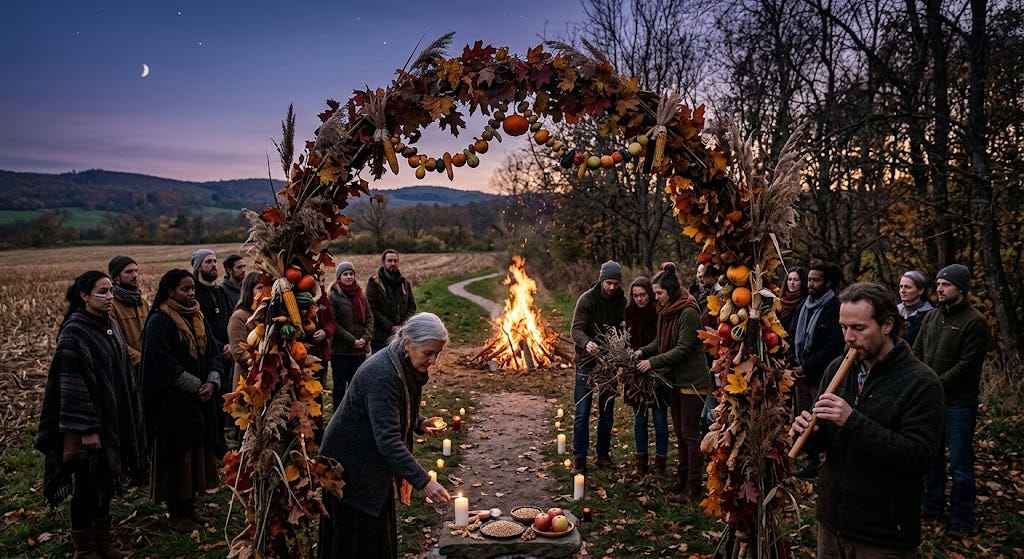
The honouring of this autumn cross-quarter gate is common across global histories; it reflects a shared human understanding of liminal intervals and cosmic thresholds. When the harvest concludes and the physical landscape enters its necessary period of decay, human consciousness across disparate geographies has systematically constructed rituals to bridge the visible and invisible worlds.
These historical systems demonstrate that the confrontation with winter’s dark half is an ancient, cross-cultural necessity required to maintain structural order within the community.
The Hellenistic Pyanopsia and the Ascending Subterranean World
In classical Greece, the late autumn transition was anchored by the Pyanopsia, a festival dedicated to Apollo’s solar withdrawal and the concurrent appeasement of chthonic entities; households hung the eiresione—an olive branch bound with wool, figs, and seasonal fruits—at their thresholds to ensure continuous protective insulation during the dark months. Simultaneously, the Thesmophoria celebrated the descent of Persephone into the subterranean realm; this was a strict, gender-segregated ritual that mirrored the agrarian reality of seeds being buried deep within the dark earth.
To the Hellenistic mind, the threshold between the living and the dead was not an adversarial barrier; it was a rhythmic, seasonal transit requiring precise ritual containment to guarantee the eventual return of the light.
Harrison, Jane Ellen. Prolegomena to the Study of Greek Religion. Cambridge UP, 1903.
The Celtic Sidhe and the Bone-Fires
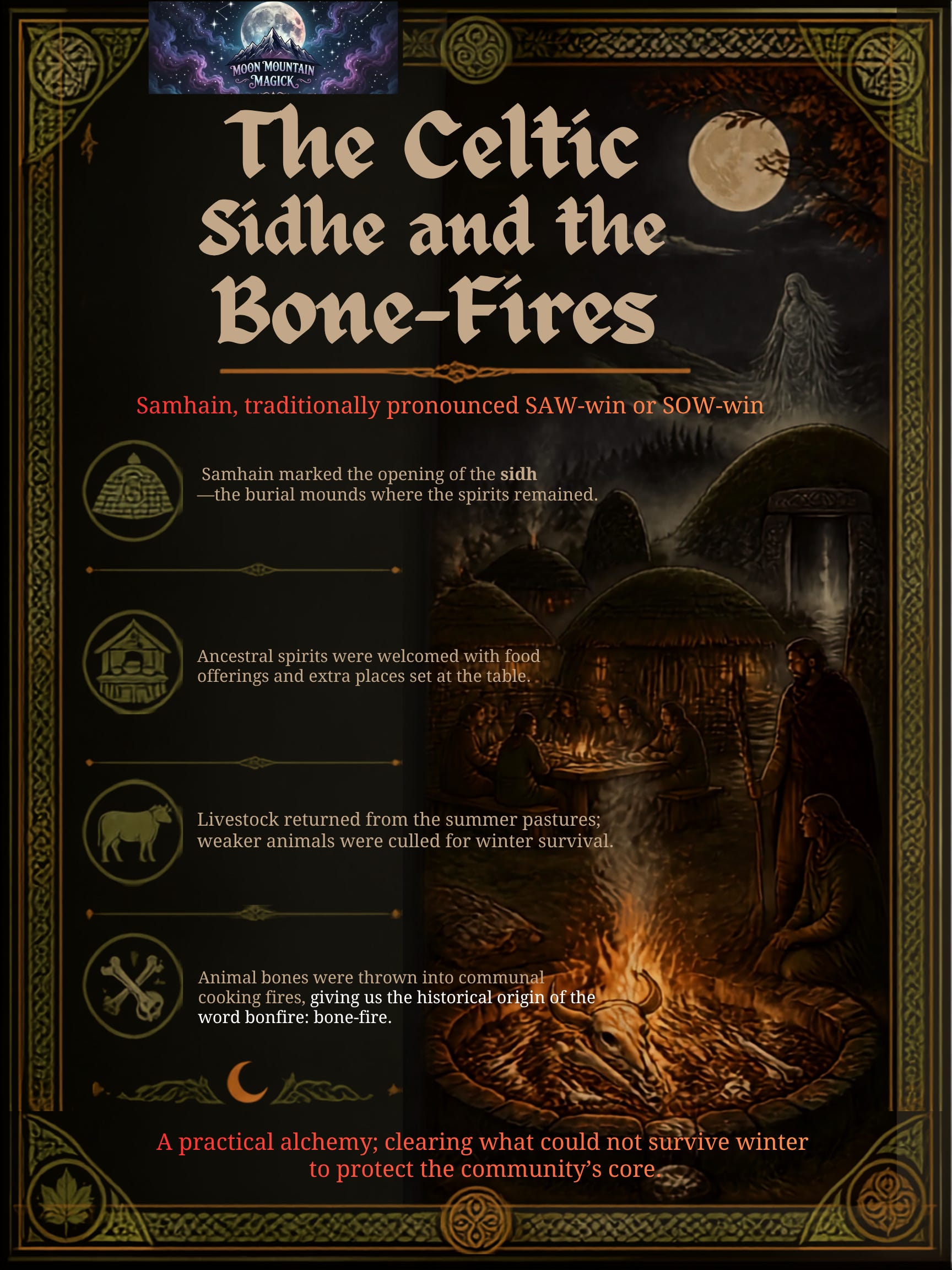
To the ancient Celts, Samhain—again, traditionally pronounced SAW-win—marked the opening of the sídh — the burial mounds where the spirits resided. The boundaries between worlds became completely permeable, and ancestral spirits walked freely through the settlements; communities left food offerings and set extra places at the table to ensure the dead remained at peace. Livestock were brought in from the summer pastures, and the weak animals were culled for winter survival; their bones were thrown into the communal cooking fires, giving us the literal historical origin of the word “bonfire” (bone-fire).
This was a practical, necessary alchemy; they cleared out what could not survive the winter to protect the core of the community.
Ó hÓgáin, Dáithí. The Sacred Isle: Belief and Myth in Pre-Christian Ireland. Boydell Press, 1999.
Odin and the Wild Hunt: The Nordic Transits
In the Nordic tradition, this period aligns with the onset of Vetrnætr (Winter Nights) and the terrifying ingress of the Ásgardreið — the Wild Hunt. Led by Odin in his aspect as Alföðr (Allfather) and lord of the dead, he rides across the stormy autumn skies on his eight-legged steed, Sleipnir, gathering the souls of the departed. This is the season of the Dísablót, a sacred sacrificial feast held to honour the Dísir, the female ancestral spirits and guardian deities who oversee the fate of the family line.
To the Norse mind, winter was an active battle against the frost giants; it required individuals to double down on their internal fortifications and make peace with their ancestors before the snow locked them in.
Simek, Rudolf. Dictionary of Northern Mythology. D.S. Brewer, 1993.
The Roman Mundus Patet and Threshold Security
An ancient Roman state approached liminal thresholds with intense structural discipline; this was exemplified by the ceremonial opening of the Mundus Cereris, a deep, stone-vaulted pit on the Palatine Hill. Three times a year—culminating in the late autumn window—the ritual stone sealing this pit was removed; this event was known as mundus patet, meaning the underworld is open.
During these specific intervals, all public and military operations were systematically paused; the state focused entirely on maintaining threshold security as the spirits of the dead arose to commingle with the living.
The Romans understood that a sustainable empire required regular, controlled intersections with the ancestral realm; it was a sacred balancing act between worldly administration and cosmic truth.
Fowler, W. Warde. The Roman Festivals of the Period of the Republic: An Introduction to the Study of the Religion of the Romans. Macmillan, 1899.
The Mesoamerican Threshold: From Miccaihuitl to the Modern Day
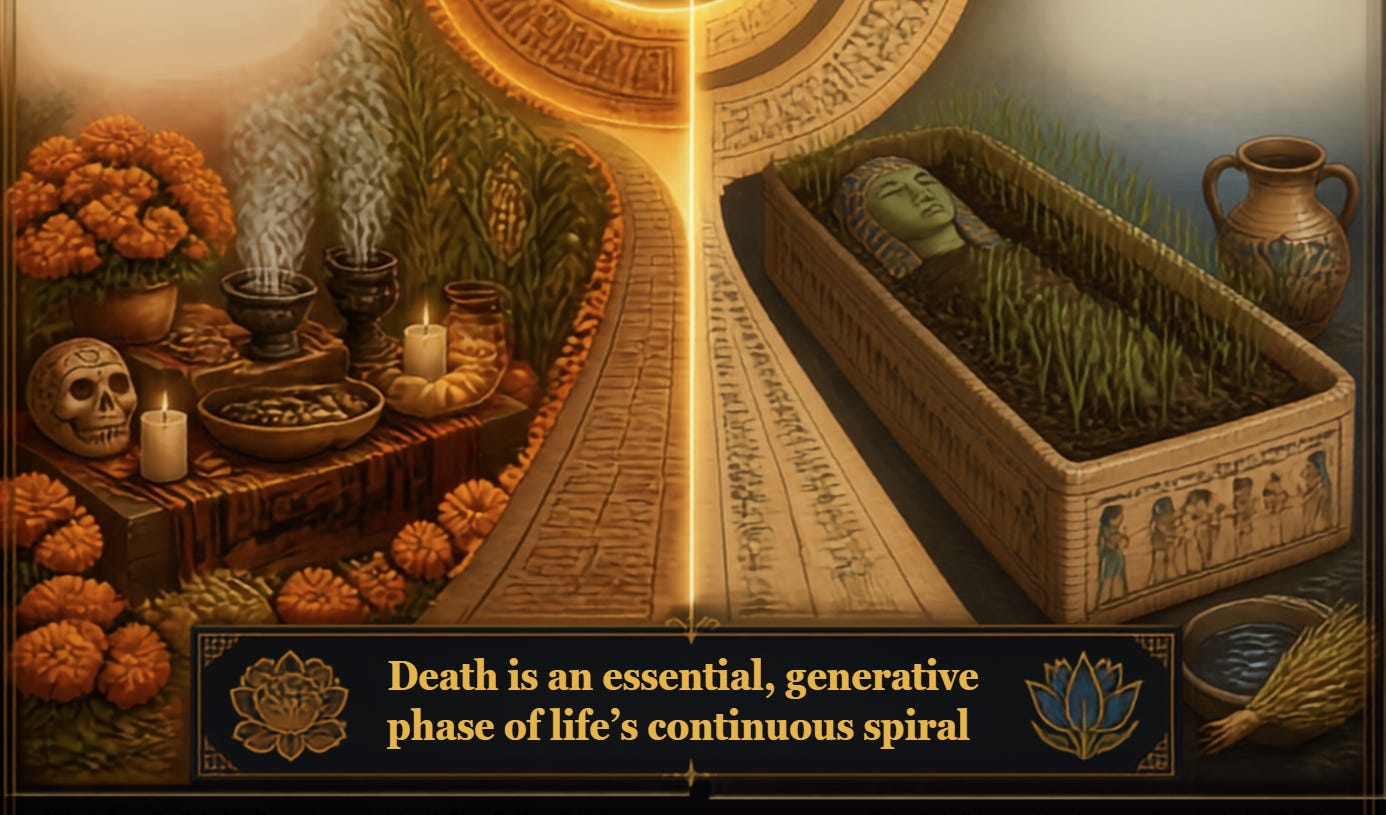
Long before the modern fusion of customs, the Aztec and Mixtec civilizations dedicated entire seasonal cycles to the dead; Miccaihuitl, the feast of the little dead, and Ueymiccaihuitl, the great feast of the departed, were strategically positioned at agricultural milestones. These ancient frameworks treated the deceased not as memories to be mourned, but as vital, active members of the family lineage who returned to receive nourishment from the living; they constructed elaborate altars utilising aromatic copal incense, bright marigolds, and feast offerings.
This ancient architecture lives on within the modern Día de los Muertos practices; it emphasizes that death is an essential, generative phase of life’s continuous spiral rather than a linear endpoint.
Milbrath, Susan. Star Gods of the Maya: Astronomy in Art and Folklore. U of Texas P, 1999.
The Egyptian Khoiak and Osiris-Soil Alchemy
In the Nile Valley, the late autumn solar decline coincided with the receding waters of the inundation; this was the exact cosmic window for the Khoiak festivals, which commemorated the murder and mystical re-assembly of Osiris. Practitioners constructed the “Osiris Bed”—a small, mummiform effigy crafted from fertile silt and planted with barley seeds; they watered these effigies in absolute darkness, watching the green shoots burst directly from the symbolic corpse of the god.
This precise ritual alchemy proved that structural regeneration is entirely dependent on darkness and decay; it provided the cosmological blueprint for the entire Egyptian funerary culture, showing that the underworld is the primary laboratory of life.
Teeter, Emily. Religion and Ritual in Ancient Egypt. Cambridge UP, 2011.
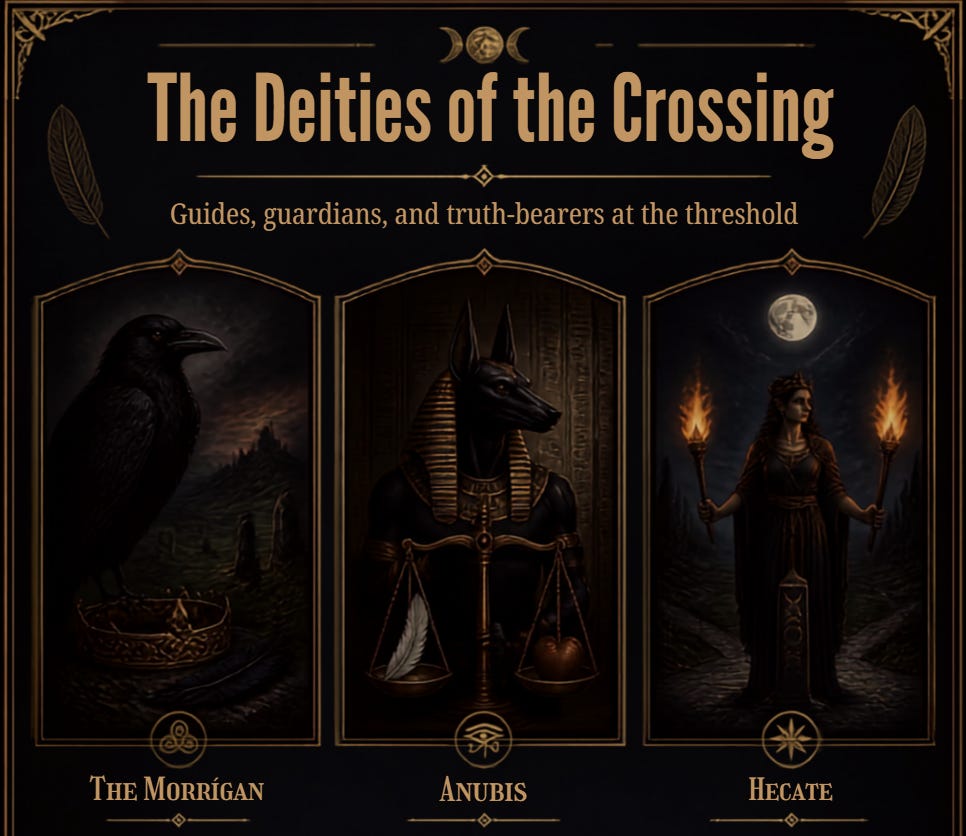
The Deities of the Crossing
The Morrígan: The Irish triple goddess of sovereignty, fate, and transitions; she moves freely between worlds and offers no superficial comfort, only absolute clarity regarding what must die so that the self can survive.
ASK YOURSELF: What is one habit, fear, or obligation that is actively draining my vitality?
The Morrígan demands a clean break—it is time to step away from the ashes without apologising or looking back.
Anubis: The jackal-headed Egyptian guardian who guides souls through the underworld and conducts the precise weighing of the heart against the feather of truth; they represent sacred accounting and absolute order within the dark.
ASK YOURSELF: Does my current life feel light and true, or is it heavy with regret and self-deceit?
Try creating a daily ledger (physically on a piece of paper, digitally in your Notes app, or mentally in your mind) and go through the days’ events.
Where are you aligned with your core values and where are you lying to yourself?
What could you change in your routine or responsibilities that would better align with YOUR feather of truth?
Hecate (sometimes spelled Hekate): The Titaness of the crossroads who carries the torches necessary to illuminate paths the living cannot see, serving as the ultimate psychopomp for ancestral work.
Darkness is NOT evil — it is a place of absolute truth, accountability, and necessary shedding. It is here, in the dark, where we find ourselves in a space of conscious transformation.
The Sky on October 31, 2026
☀️The Sun sits at 8 degrees Scorpio while Mercury is stationary retrograde at 14 degrees Scorpio, drawing our mental focus back to long-buried family secrets and ancestral lines.
The Takeaway: This is not a time for forward-looking planning; it is a time for excavation. This transit supports doing exactly what Anubis does—digging up long-buried truths, weighing them, and having the hard conversations with ourselves or our ancestors.
🌙 Crucially, the Moon sits in Cancer — the sign of its absolute rulership, governing the home, the mother-line, and the lineage as an emotional sanctuary.
The Takeaway: The emotional sanctuary of the "home" is front and centre. This is where Hecate's energy comes in—she guides the emotional journey backward into the family line. You will likely feel a strong, almost physical pull to connect with your roots, heal generational trauma, and/or honour those who came before them.
💫With Pluto (the modern ruler of Scorpio) having recently turned direct on October 16, the mandate for structural transformation is non-negotiable.
The Takeaway: This is the exact energy of The Morrígan. The universe is demanding that dead weight be cut away. The secrets unearthed by Mercury and the emotional lineage felt by the Moon are being permanently restructured by Pluto.
Navigating the Sol-Lunar Transits
During this cross-quarter threshold, our ritual focuses are governed by powerful planetary anchors:
🌑New Moon in Scorpio ♏(November 9, 2026 at 12:02 AM MST): Occurring at 16 degrees Scorpio and directly embedded within the double retrograde of Mercury and Venus, this lunation is an absolute psychological reset point. It is a silent, subterranean gate that offers zero ambient light for external vanity; it forces an honest conversation with the self regarding deep attachments and subconscious drives. To utilise this portal, remain in absolute stillness; avoid launching outward projects and focus entirely on recording dream symbols and long-buried internal insights.
🖤YOU ARE BEAUTIFUL | 🖤YOU ARE IMPORTANT | 🖤YOU ARE MAGICK
So Mote it Be,
MJ Magick
0 comments